





How does a weather station predict the weather?
As described in the previous article, home weather stations have multiple sensors to measure the weather. Most modern weather stations also have a display which shows a weather prediction. But how do these weather stations predict the weather for the coming hours? Are they even realistic predictions?

The basics
The main sensor that contributes to the weather predictions is the air pressure sensor. Another name for this sensor is a barometer. The barometer of a weather station is generally located inside the indoor unit because the air pressure inside a house is the same as outdoors. Besides the barometer, the temperature sensor or thermometer is also often used in weather prediction to distinguish between rain and snow. Before learning about how air pressure influences the weather, let’s just take a quick look at the history of the barometer.
The history and types of the barometer
The barometer has been around for quite a while. The Italian scientist Evangelista Torricelli invented the first contraption to measure air pressure in 1643. The barometer consisted of a container filled with mercury. Inside this container, there was a tube sticking out. The higher the mercury went up inside the tube, the higher the air pressure.
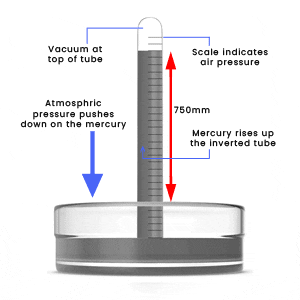
Today there are a couple of often-used types of barometers:
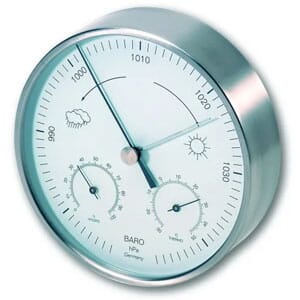
Aneroid barometers: a type of barometer that doesn’t include a liquid, but instead a small box, called an aneroid capsule. It’s an analogue instrument that can be often found as a simple device to predict the weather.
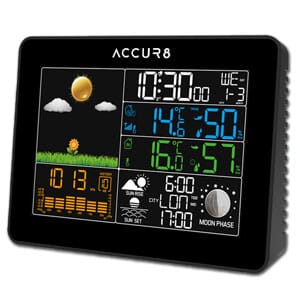
Electric barometer: this type of barometer is most commonly used in electronic devices and home weather stations. It converts the air pressure into numerical values which can be interpreted and displayed by the weather station.
Low-and high-pressure zones
The daily weather is heavily influenced by low-and high-pressure zones. At sea level, the worldwide mean air pressure is 1013hPa. Hectopascal (hPa) is the most commonly used unit to describe air pressure. But other units like mmHg (the original unit created by Torricelli) can be used too. If the air pressure is higher than its surrounding, it’s called a high-pressure zone. High-pressure zones tend to come with fairly dry and calm weather. Low-pressure zones are the opposite, they can come with rain and strong winds.
Around low-pressure zones, the wind blows anti-clockwise in the Northern Hemisphere. Around a high-pressure zone, the wind moves in a clockwise direction. In the Southern Hemisphere, it’s the other way around. An example: if there is a low-pressure zone located to the west of your location (in the Northern Hemisphere) and a high-pressure zone to the east, there will be a southerly wind. The wind strength depends on the difference in pressure between the low-and high pressure zones and the distance between them.
Weather types
Although there is some difference between different makes of weather models, these are the most often occurring weather types predicted by the weather station: